“While this lawsuit focuses on the project’s competitive bidding and ownership process, our concerns about the proposed transmission line’s impacts on Anza-Borrego Desert State Park and surrounding communities remain.This legal action is one part of our broader effort to protect the Park. We continue working alongside our partners, community members, and public officials through advocacy, public education, and regulatory engagement,” the Foundation states on Facebook, adding, “We’re committed to keeping you informed and doing everything reasonably within our power to protect Anza-Borrego for future generations.”
Miriam Raftery • November 26, 2026
SDG&E Changes Proposed Route of Golden Pacific Powerlink; Anza-Borrego Foundation files antitrust lawsuit
Share
By Miriam Raftery, www.eastcountymagazine.org
The Anza Borrego Desert Foundation and a coalition of others filed a lawsuit late last week against SDG&E and the California Independent Systems Operator (CAISO alleging CAISO violated antitrust law by awarding the Golden Pacific Powerlink project to SDG&E, despite another company putting in a much lower bid. But SDG&E has doubled down on its determination to run the line through California’s largest state park.
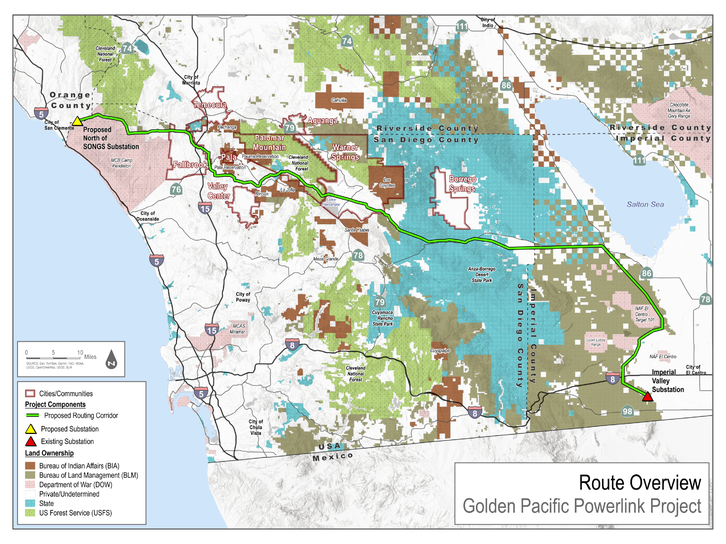
On Nov 20, SDG&E released a revised proposed route for the controversial 150-mile high voltage powerline that would bypass Temecula, but slice through Palomar Mountain and other northeast county communities including tribal lands, while still traversing the heart of Anza Borrego Desert State Park despite strong opposition from Borrego residents and environmental groups.
The new preferred route
The new route would slice through Fallbrook, Pauma Valley and along State Route 76, through Valley Center and the most populated area of Palomar Mountain along the southern portion of the mountain. It would also threaten waterways in Warner Springs, Lake Henshaw, and five bands of the San Luis Indian Water Authority, as well as march through scenic areas and habitat for endangered Peninsular Bighorn Sheep in Anza-Borrego Desert State Park.
The antitrust lawsuit
“The lawsuit challenges how SDG&E gained responsibility for the proposed Golden Pacific Powerlink transmission line after another company (Horizon West Transmission LLC) was selected through a competitive bidding process,” the ABDF announced on Facebook. “It alleges violations of California’s antitrust and unfair competition laws.” The suit also contends that SDG&E customers would shoulder higher utility rates to fund the line, in a region already paying among the highest utility costs in the U.S.
The suit was filed by attorneys from Aguirre & Severson LLP in San Diego and DeBlase Brown Eyerly LLP of Los Angeles on behalf of two nonprofits, ABDF and Borrego Community Development Corporation, as well as 21 individuals.
The suit states that Horizon West’s base capital cost was around $1 billion for both the 500 kV transmission line from Imperial County to Orange County as well as a new substation, compared to SDG&E’s estimated capital cost of $1.62 billion to build only the transmission line, not the substation. The suit accuses utilities of conspiring with CAISO to allow SDG&E to fund, build and maintain the powerline while Horizon West would be responsible for the substation.
Bill Powers, a plaintiff in the suit, told inewssource he believes the need for the project should be reassessed and solar panels analyzed as a more affordable and less environmentally destructive solution to meet electricity demands. “It’s just become an existential nationwide fight to kneecap rooftop solar and double down on the need for transmission,” he said.
New proposed route draws opposition from communities across northeast San Diego County
SDG&E, after hearing community input from more than 1,500 people at four in-person and four-online forums, has announced it has revised its proposed route to eliminate going through Temecula, where it had drawn strong opposition from Temecula’s mayor, city council, and local tribes. The utility now plans to ask the California Public Utilities Commission (CPUC) to approve the alternative South Mountain Route because it has “potential to reduce certain environmental impacts and address engineering challenges.
Like every potential route, however, it presents different considerations that require continued study and engagement with potentially affected communities,” SDG&E stated in its announcement of the changes. The utility pledged to engage with potentially affected communities to hear concerns and provide information.
SDG&E has posted updated maps and additional information on the Golden Pacific Powerlink project website.
Community groups along the proposed powerline route organize opposition
Below are comments posted on social media from key stakeholder groups.
City of Temecula: The City of Temecula issued a statement praising the collective efforts of the city and community to get Temecula removed as the preferred route, it also notes that Temecula remains a potential option as `The Riverside County Alternative’ route. The statement affirms that “the City’s opposition remains unwavering—and our work will not be done until Temecula Valley is removed from considering entirely.”
Anza-Borrego Foundation: The nonprofit seeks donations to fund its lawsuit against SDG&E and CAISO.
For more information you can https://theabf.org/park-threat/, read about Anza-Borrego Desert State Park, and donate to the Anza-Borrego Foundation to fund its efforts to protect the park, including the lawsuit.
Save Palomar Mountain: “Abandoning the Riverside County Route weeks before filing concedes that Temecula’s multi-agency record was untenable. Yet the South Mountain Route trades one unmitigable set of impacts for an equally formidable wall of water districts, tribal sovereigns, and backcountry fire coalitions—strengthening the case for an SB 1006 non-wires alternative.”
The group cites obstacles along the South Mountain Route including “direct collision with sovereign water immunity” from three districts as well as causing “evacuation choke points” that would make it difficult for community and tribal members to evacuation in a wildfire. The line would skirt he Pala, Pauma and Rincon reservations as well as five bands of the San Luis Indian Water Authority, triggering strict AB 52 Tribal Cultural Resource protections as well as threatening evacuation routes along State Route 76 and East Grade Road.
Learn more SavePalomarMountain.org.
Save Pauma Valley: The citizens’ group notes that Cal Fire found SDG&E lines responsible for starting the 2007 Witch, Guejito and Rice fires in North County and voices fears that 200-foot-tall towers in fire-prone areas could delay firefighters from extinguishing fires that start under an energized line, noting it can take time to shut off high voltage lines. “The CPUC has said no before,” Save Pauma Valley notes. “In 2002 it rejected SDG&E’s Valley-Rainbow 500 kV line as not needed and not cost-effective.”
The group urges the public to visit https://savepaumavalley.org and to join the coalition opposing the line at https://wesavecalifornia.org.
Fallbrook Land Conservancy: The group opposes the Golden Pacific Powerlink as proposed, citing responsibility to protect natural habitats, wildlife corridors, watersheds, and open spaces. The Conservancy’s concerns fall into three categories: “(1) the larger question of whether this transmission is necessary at all, (2) the local question of how to minimize environmental damage if it is ultimately constructed, and (3) the fairness of the imbalance between regional benefits and local environmental consequences.” Learn more at https://www.fallbrookland.org/nwes/goldpacificpowerlin under News.

Author: Miriam Raftery
Miriam Raftery is the founder and editor of East County Magazine, a nonprofit news outlet serving San Diego County’s East County communities. An award-winning journalist with more than 35 years of experience, she covers local government, public safety, environmental issues and investigative news.
Learn More About Borrego Springs
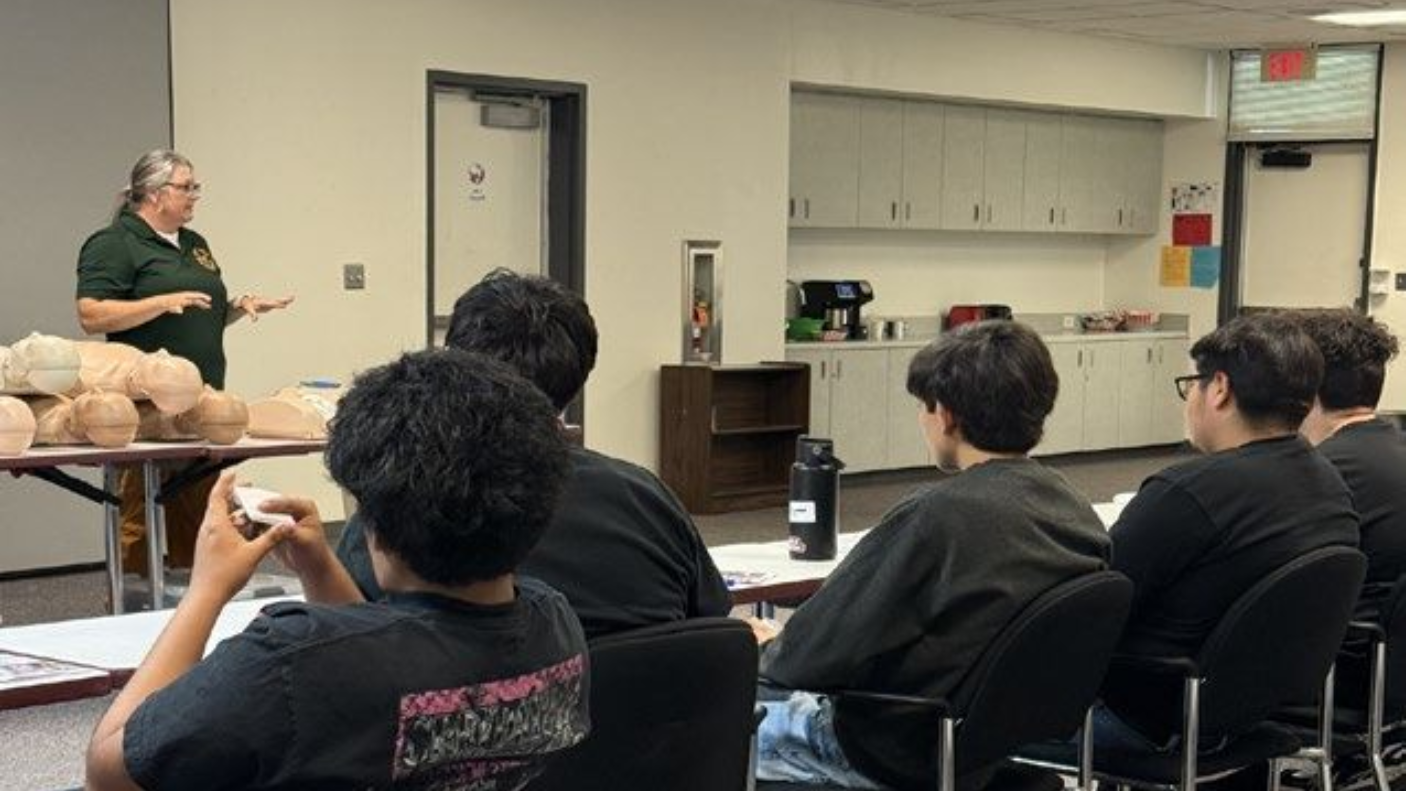
Borrego Village Association brings lifesaving training to the community with support from the Borrego Valley Endowment Fund On November 6, 14 Borrego Springs High School students and 6 teachers earned certification in CPR and first aid during a training held at the school. The Borrego Village Association organized the class with its implementing partner, Kit Fox Outfitters of Ramona. Kit Fox taught the CARE CPR and First Aid Certification Training using the American CPR Training curriculum. Participants learned how to recognize and respond to medical emergencies, perform CPR and give basic first aid. The day combined classroom instruction and discussion with hands-on practice. Students and teachers practiced CPR on infant manikins, packed wounds and applied tourniquets. According to the Kit Fox grant summary, bringing the training directly to the high school helps more people in Borrego Springs get emergency preparedness education. Borrego Springs is a rural backcountry community some distance from major medical facilities. Students and educators who know how to respond to an emergency make the school, and the wider community, better prepared. The high school class is one piece of a larger community effort. "Thanks to a generous grant from the Borrego Valley Endowment Fund , the Borrego Village Association, with our implementing partner Kit Fox Outfitters from Ramona, CA, will have facilitated one Wilderness First Aid and seven Emergency First Aid + CPR/AED certification classes for a projected 97 people in our community over the last 10 months!" said James Dion, Executive Director of the Borrego Village Association. Photos courtesy of Kit Fox Outfitters
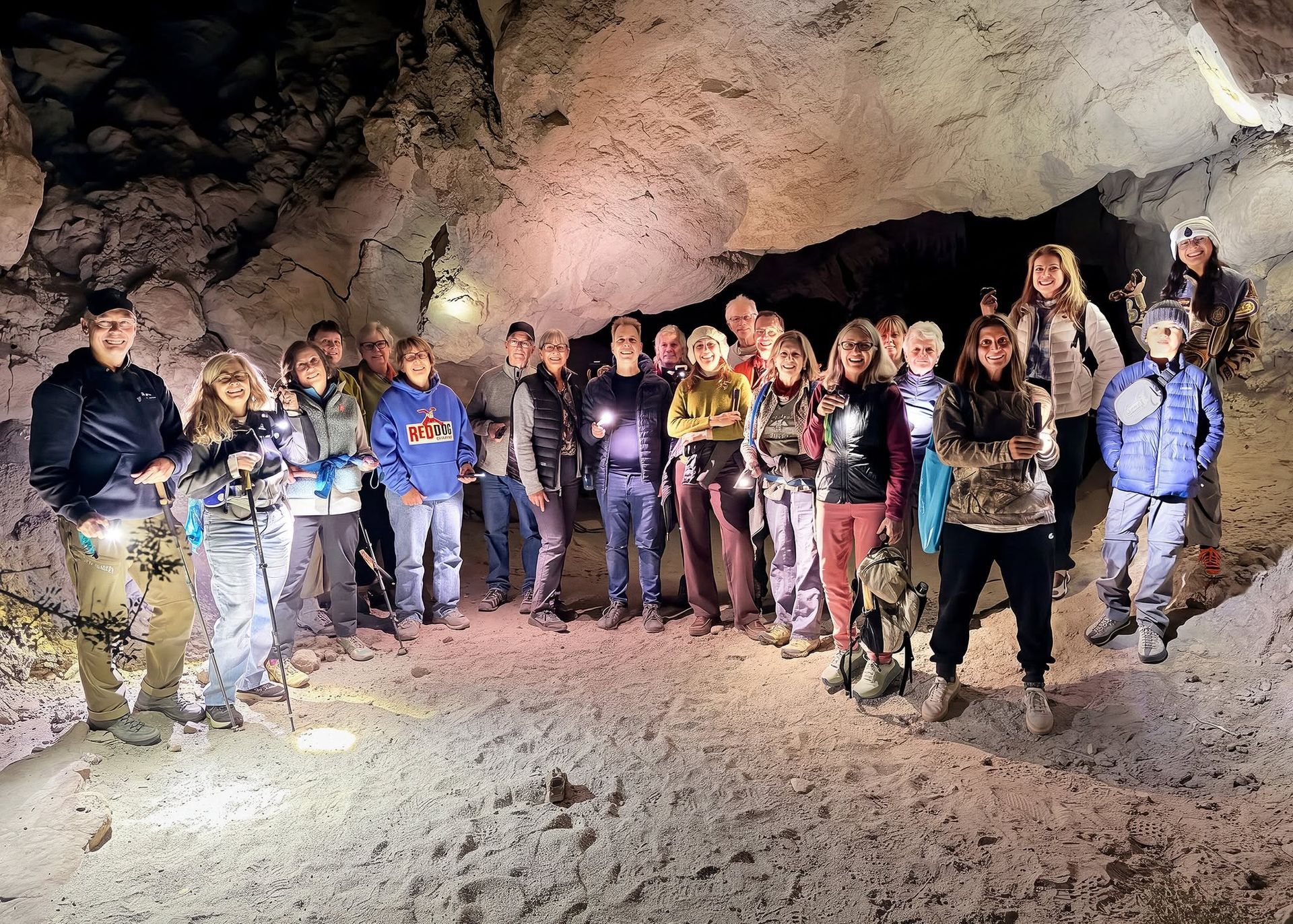
The Anza-Borrego Desert Natural History Association (ABDNHA) hosted a full moon walk.
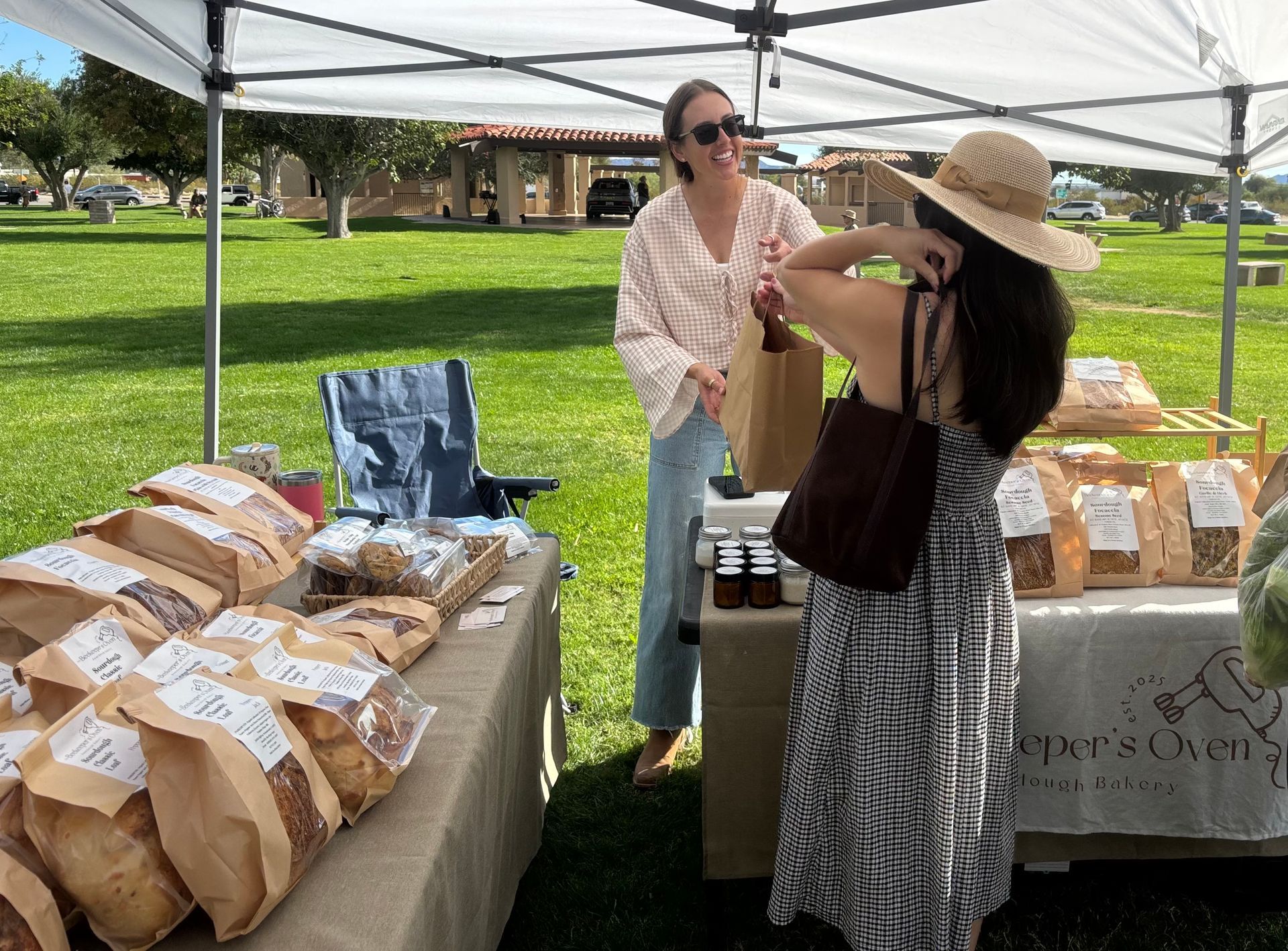
Friday Mornings at Christmas Circle

We swat them and spray them, yet these tiny creatures are essential to life in Anza-Borrego desert.

Borrego Springs residents and businesses are encouraged to share feedback on trash, recycling and organic waste services. The County of San Diego is seeking public input on its Strategic Plan to Reduce Waste, an initiative aimed at improving waste collection and recycling services throughout the county’s unincorporated communities, including Borrego Springs. The County aims to achieve 90% waste diversion by 2045. Community feedback will help shape future trash, recycling, food and yard waste services, as well as education and outreach efforts. Residents and businesses are encouraged to participate in the community survey and public meetings taking place during November and December 2026. Get Involved Take the community survey Attend a community meeting Submit questions and feedback The updated plan is expected to be presented to the County Board of Supervisors in fall 2027. For more information, visit engage.sandiegocounty.gov/wastereduction or email Recycle@sdcounty.ca.gov .
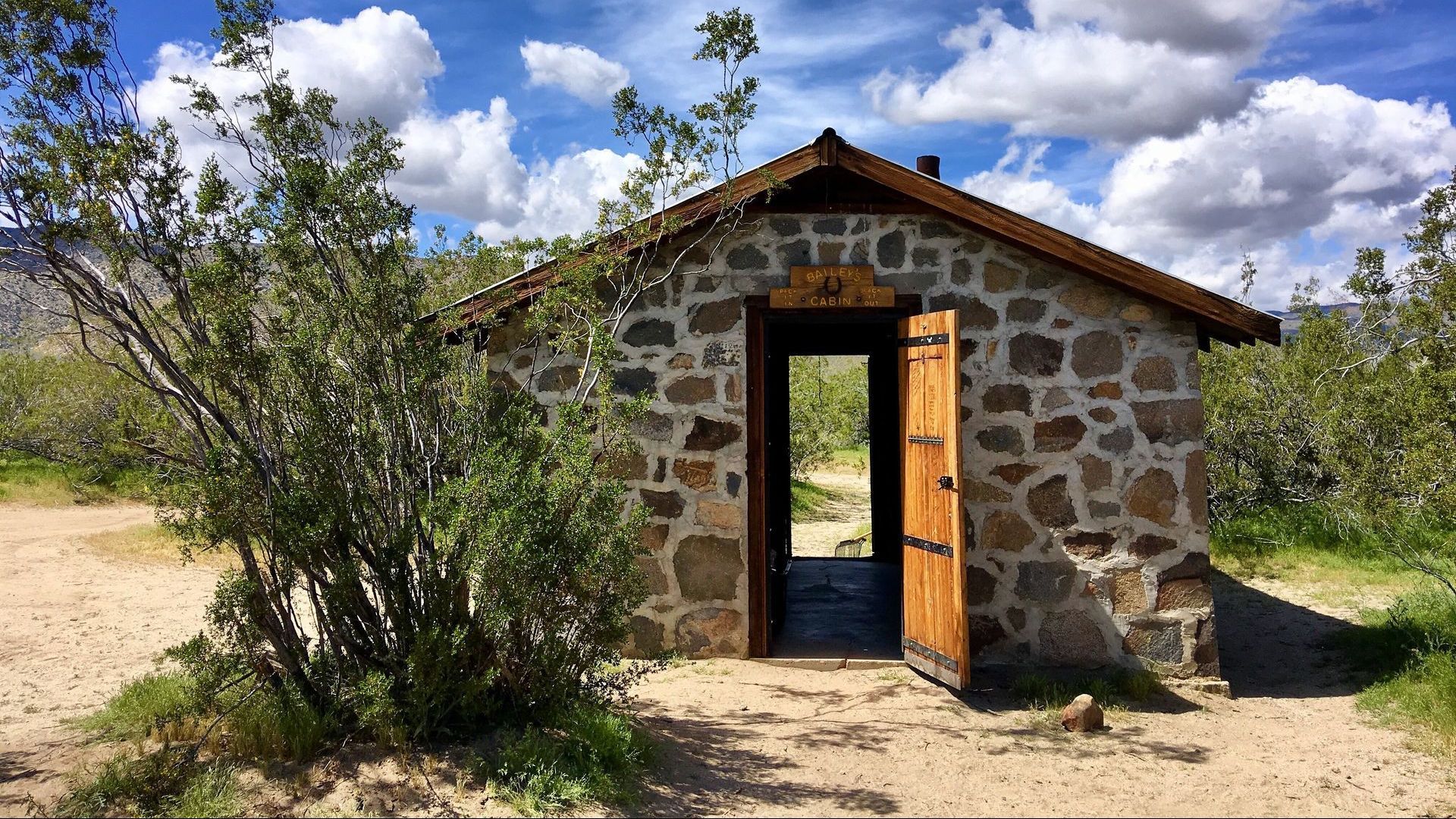
Learn about Bailey's Cabin's history & camping tips in Upper Coyote Canyon. Enjoy stargazing & adventure in Anza-Borrego Desert State Park!
Borrego Art Institute and The Gallery at The Palms welcome visitors for an evening of art Borrego Springs ArtWalk will take place Saturday, December 5, from 5 to 7 p.m., with Borrego Art Institute and The Gallery at The Palms welcoming residents and visitors to explore their galleries. Part of the 2026–27 ArtWalk season, the event brings evening gallery visits to Borrego Springs on the first Saturday of the month. The December gathering offers an opportunity to browse exhibitions and include both locations in a night out around town. Borrego Art Institute is located at 665 Palm Canyon Drive, at Christmas Circle. The Gallery at The Palms is located at The Palms at Indian Head, 2220 Hoberg Road. For more information, contact Borrego Art Institute at 760-767-5122 or gallery@borregoartinstitute.org , or The Gallery at The Palms at 760-767-7788 or stay@thepalmsatindianhead.com .

The word Advent means “coming.” It is the start of the church year, which will take us.

A day of holiday festivities on December 19 includes Holly Day at The Center followed by a live theatrical performance streamed from Julian. Celebrate the holidays in Borrego Springs on Saturday, December 19, 2026, with a full day of community festivities, entertainment and Christmas traditions. The Borrego Springs Performing Arts Center (BSPAC) will present a live screening of Charles Dickens’ A Christmas Carol from 2 to 4 p.m. Streamed directly from Julian, the production is brought to Borrego Springs by the East County Performing Arts Association. Audience members can enjoy cider and sweet treats while watching the classic holiday story on the big screen. Holly Day at The Center Before heading to the theater, join friends and neighbors for Holly Day at The Center, a free community holiday celebration from 10 a.m. to 2 p.m. The family-friendly gathering will feature music, photos with Santa, a raffle, hot cocoa, cider and a special appearance by the Queens. Those interested in participating as vendors can contact propertymanager@bvef.org . Following the festivities, head over to the Performing Arts Center to enjoy A Christmas Carol. A Christmas Carol – Event Details Date: Saturday, December 19, 2026 Time: 2–4 p.m. Location: Borrego Springs Performing Arts Center, 590 Palm Canyon Drive Tickets: BSPAC.org Admission to Holly Day at The Center is free. Tickets for A Christmas Carol are sold separately.