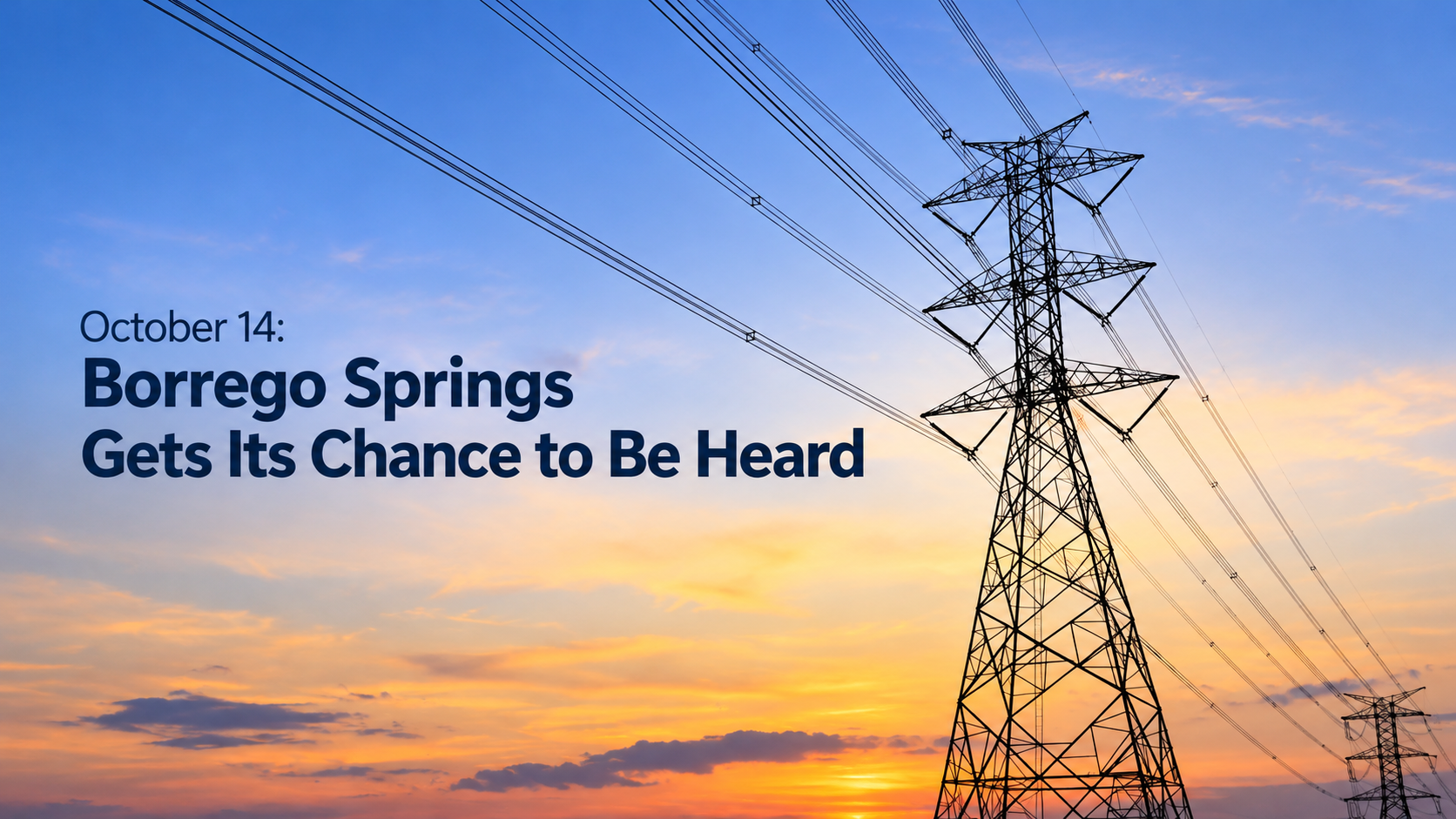
SDG&E will come to Borrego Springs on Wednesday, October 14, from 4:00 to 7:00 p.m. at the Borrego Springs Resort to discuss its proposed Golden Pacific Powerlink. If you care about Borrego Springs and Anza-Borrego Desert State Park, please be there.
The Golden Pacific Powerlink, or GPP, is SDG&E’s proposal for an approximately 135-mile, 500-kilovolt transmission line running from the Imperial Valley toward the San Diego–Orange County border. The currently “preferred” route would take this enormous piece of industrial infrastructure directly through Anza-Borrego Desert State Park. And not merely along its edge. The proposed route begins in Imperial County and follows Highway 78 to Tamarisk Grove. From there it goes up Grapevine Canyon and through the Angelina Spring Cultural Preserve. Towers would rise 150 to 200 feet above a landscape that Californians have protected for the last 100 years.
On October 14, SDG&E is giving Borrego Springs an opportunity to respond to their proposal.
We should.
We Have Been Here Before
Perhaps the most astonishing fact about the Golden Pacific Powerlink is that California definitively addressed this ill-conceived route two decades ago. In the mid-2000’s, SDG&E proposed routing another 500 kV transmission line—the Sunrise Powerlink—through the State Park. After extensive environmental review, the California Public Utilities Commission rejected all routes through the Park as “environmentally unacceptable and infeasible,” identifying 52 significant and unmitigable environmental impacts. The Sunrise Powerlink was ultimately routed around the Park.
Now compare the proposed GPP corridor with the old Sunrise proposal. Through the State Park, the routes are virtually identical. Both originate at the Imperial Valley Substation and travel along Highway 78 to Tamarisk Grove. Both follow the old 69 kV right-of-way up Grapevine Canyon, and through the Angelina Spring Cultural Preserve.
So there is an obvious question for SDG&E:
What Has Changed?
Certainly not the value of the Park. If anything, the argument for protecting the Park is stronger today than it was 20 years ago. Research by scientists from Borrego’s Steele/Burnand Desert Research Center documents an almost 40 percent decline in native vegetation across the Colorado Desert region since the 1980s. Long-term observations inside the Park have documented declines in iconic desert plants. Portions of San Felipe Creek have dried up. Peninsular bighorn sheep remain under enormous environmental pressure. The desert did not become less precious or fragile since 2008 when this route through the Park was rejected. It became more vulnerable.
There Is Another Way to Think About Electricity
There is also a larger issue behind GPP.
For most of the last century, our electrical system was built around a simple model: utility companies generated electricity and distributed it as cost effectively as possible to their customers. However, the advent of rooftop solar was the death knell for this business model as it meant utilities no longer had a monopoly on the generation of electricity, so they pivoted. Now they make money by building enormous transmission lines—the longer and more expensive, the more profitable given the nearly 10% regulated rate of return on approved capital investment.
GPP is the embodiment of that business model.
But another model is emerging.
Public Power San Diego, which advocates replacing SDG&E within the City of San Diego with a nonprofit municipal utility, has proposed much greater reliance on electricity generated and stored closer to where it is consumed: rooftop solar, parking-lot solar, local battery storage, microgrids and other distributed resources.
That does not mean transmission will, or should, completely disappear. California will continue to need a robust electrical grid. But it raises a question that should precede construction of every new multibillion-dollar transmission project:
Have we done everything reasonably possible to generate and store electricity closer to where it will actually be used?
That question becomes especially important when the alternative is driving a 500 kV industrial transmission corridor through California’s largest State Park which contains 85% of California’s state designated wilderness.
Follow the Economics
There is another part of this discussion that should not be ignored.
SDG&E is an investor-owned utility. It has shareholders, and those shareholders expect a return on their investment.
Under California’s regulatory system, SDG&E has the opportunity to earn a regulated return on approved capital investment. For 2026–2028, the CPUC authorized SDG&E a 9.93 percent return on common equity.
Meanwhile, SDG&E’s parent company, Sempra, reported more than $3 billion in adjusted earnings for 2025.
None of this proves that GPP is unnecessary.
But it does make the economics of utility infrastructure a legitimate subject for public scrutiny.
When a utility proposes a multibillion-dollar capital project, the public should ask not merely whether it can be built, but whether it needs to be built, whether less destructive alternatives exist, who will pay for it, and who will financially benefit from it.
GPP Is Not Just a Power Line
There is another lesson from Sunrise.
Large transmission corridors facilitate additional industrial development.
After Sunrise was completed, major utility-scale renewable projects followed, including the 112-turbine Ocotillo Express Wind Facility covering more than 10,000 acres. Also of note are the hundreds of acres of solar farm being build around the small community of Jacumba Hot Springs. SDG&E itself described these developments as precisely the sort of projects the Sunrise Powerlink had been designed to support.
So the decision before us is larger than whether we can tolerate another set of towers.
It concerns whether we want to establish another industrial energy corridor through one of the most extraordinary desert landscapes in North America. San Diego County’s Regional Decarbonization Framework has identified Borrego Springs as the low-cost alternative for siting industrial scale solar farms—farms that would dwarf the two already present in the Borrego Valley.
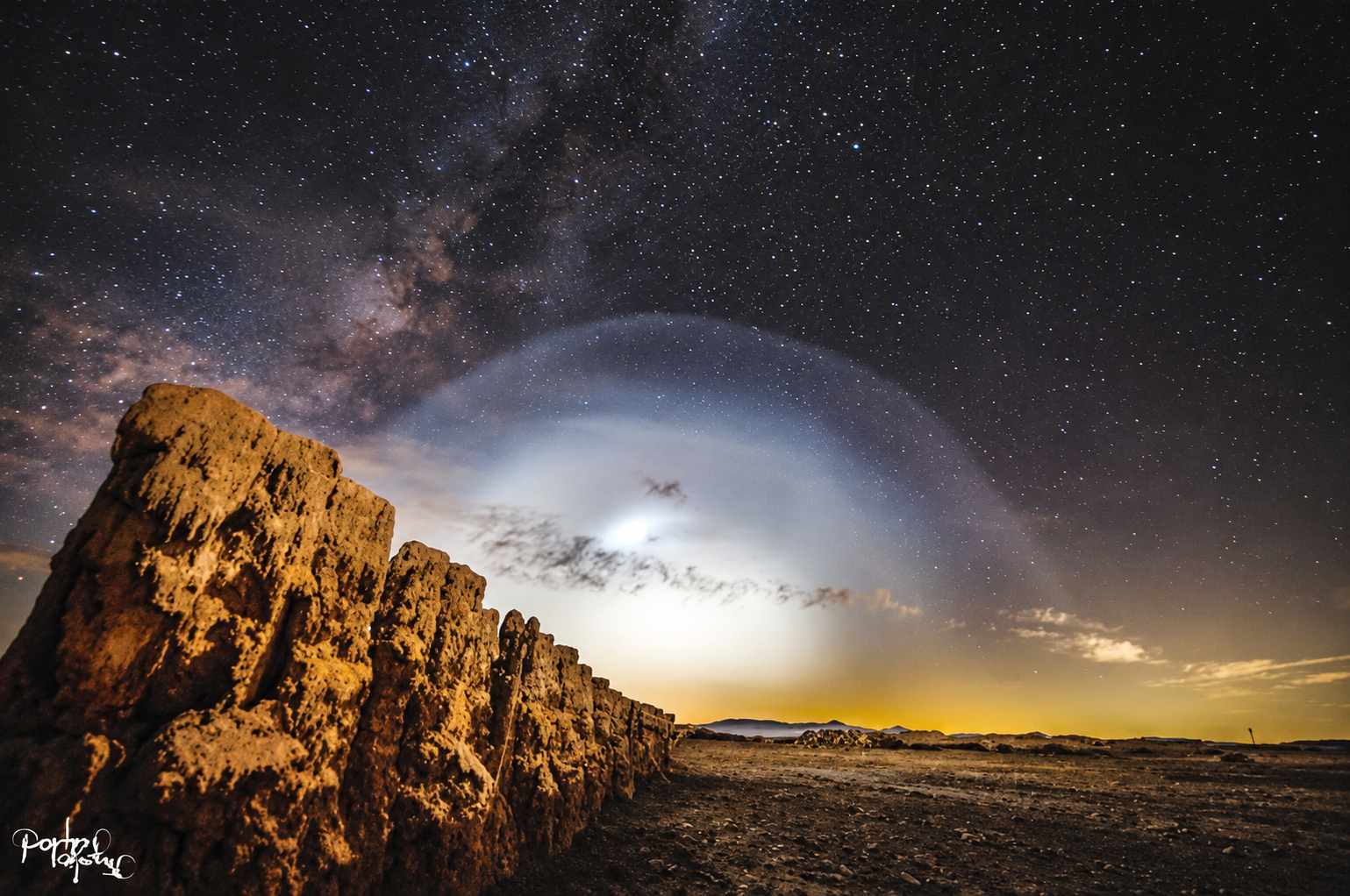
The Anza-Borrego Desert State Park spans more than 650,000 acres. It provides habitat for endangered Peninsular bighorn sheep, contains extraordinary paleontological resources, is an International Dark Sky Park, and forms part of a UNESCO-recognized biosphere reserve.
It is also the economic foundation of Borrego Springs. People do not travel here to see industrial infrastructure. They come because there are still places in Southern California where the horizon belongs to mountains, desert, and sky.
October 14: Show Up
There will be lawyers, engineers, consultants, environmental studies and regulatory proceedings before this is over.
But on October 14, SDG&E is coming to us.
So come with questions.
- Ask why a route substantially similar to one rejected in 2008 is being proposed again.
- Ask what alternatives have been examined.
- Ask whether distributed solar, batteries, microgrids and other local resources in San Diego and in Los Angeles could reduce the need for long-distance transmission.
- Ask what portion of the electricity carried by GPP will actually come from renewable generation.
- Ask what this project will ultimately cost ratepayers.
- Ask what SDG&E and its shareholders stand to earn from the investment.
- And ask why one of California’s greatest State Parks should be asked to bear the environmental cost.
Then tell SDG&E what you think.
Community Meeting
Wednesday, October 14, 2026
4:00–7:00 p.m.
Borrego Springs Resort
Anza-Borrego has faced threats like this before. It survived them because people who loved this place decided to stand up and protect it. Now, it’s our turn.
Show up. Speak up. And make damn sure Borrego Springs is heard.
Learn More and Get Involved
For more information on how you can protect the Park and our community, visit: