Andrea McKenna • November 21, 2026

November 29: Experience Shape Note Singing at St. Barnabas

Share
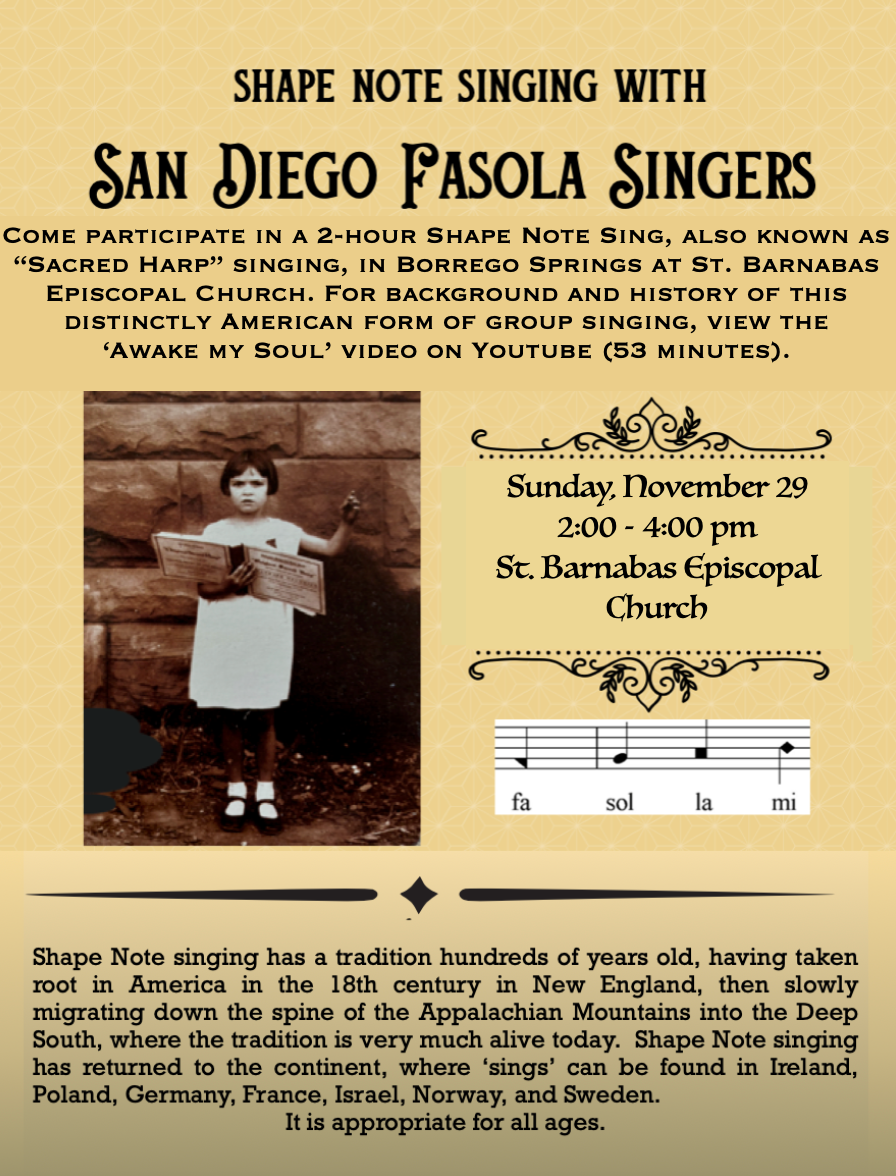

The San Diego Fasola Singers invite the community to discover a centuries-old American singing tradition at St. Barnabas Episcopal Church on November 29.


The San Diego Fasola Singers are coming to Borrego Springs for a two-hour shape note singing gathering on Sunday, November 29, from 2 to 4 p.m. at St. Barnabas Episcopal Church.


Also known as Sacred Harp singing, this distinctly American tradition brings people together to sing four-part harmonies without instrumental accompaniment. Rather than performing for an audience, participants sing together, making everyone part of the music.


Shape note singing developed in early America, with roots in 18th-century New England singing schools. It later became especially popular in the Appalachian Mountains and the Deep South, where the tradition continues today.


The name comes from the use of differently shaped musical notes that help singers recognize pitches. In the traditional four-shape system, the notes are called fa, sol, la and mi. Singers often begin by singing these syllables before singing the words of a hymn.


Sacred Harp gatherings are known for their powerful harmonies and distinctive seating arrangement. Singers typically sit in a hollow square, with each of the four voice parts facing inward. A leader stands in the center to guide the group.


Unlike a conventional choir concert, Sacred Harp singing emphasizes participation, community and the shared experience of making music. Singers of different ages and experience levels are welcome, and no professional musical background is required to take part.


The tradition has also found new audiences internationally, with singing groups in countries including Ireland, Germany, Poland, France, Norway and Sweden.

Those interested in learning more about the history of Sacred Harp singing can watch the 53-minute documentary Awake, My Soul: The Story of the Sacred Harp on YouTube.


Event Details


Shape Note Singing with San Diego Fasola Singers

  • Sunday, November 29, 2026
  • Time: 2–4 p.m.
  • Location: St. Barnabas Episcopal Church, Borrego Springs
  • All ages welcome


Community members are invited to come participate and experience this longstanding American musical tradition firsthand.


Learn More About Borrego Springs
By Golden Pacific Powerlink Project Team • November 20, 2026
Dear Community Member, Thank you for being part of the conversation. More than 750 community members joined us at recent open houses in Fallbrook, Temecula, El Centro and Borrego Springs. Thank you to everyone who took the time to attend, ask questions and share their thoughts and concerns. We recognize that a project of this size can raise important questions. Your feedback matters, and the time you have taken to share your perspective is an important part of the planning process. Since the beginning of community outreach we have: Connected with more than 1,500 community members at 4 virtual and 4 in-person open houses Participated in over 200 briefings and meetings with community groups, tribes, agencies, elected officials and other stakeholders Reviewed and responded to more than 1,400 emails, web comments and phone calls Collected more than 1,000 in-person or online surveys Welcomed more than 24,000 visits to our project website An Update to the Proposed Route As project planning has advanced, we have continued to evaluate the preliminary proposed routing corridor and feasible alternatives. This work includes reviewing engineering and environmental studies and feedback from community members and other stakeholders. Changes to a proposed route are a normal part of responsible project planning as new information becomes available. Based on the information gathered through this work, SDG&E plans to adjust the project’s proposed route. SDG&E is revising its proposed route from the Riverside County Route to the South Mountain Route in our application to the California Public Utilities Commission (CPUC). Studies and stakeholder feedback gathered to date indicate this change has the potential to reduce certain environmental impacts and address engineering challenges. Like every potential route, however, it presents different considerations that require continued study and engagement with potentially affected communities. This update reflects SDG&E’s commitment to minimizing potential impacts where feasible, incorporating stakeholder input and continuing environmental, cultural and engineering review. What Happens Next? The CPUC will independently review the proposed project and alternatives to ultimately determine the final route. We recognize that this update may raise new questions or concerns. We are committed to engaging directly with potentially affected communities, listening to their concerns and providing information as the review moves forward. Updated maps and additional information are available on the Golden Pacific Powerlink project website. Background G olden Pacific Powerlink , a proposed electric transmission line being developed by SDG&E, is intended to help strengthen California’s regional power grid and maintain future reliability as the state electricity needs continue to grow. The proposed 500-kilovolt line was identified by the California Independent System Operator (CAISO), the state’s independent transmission planning authority, who oversees the state’s electric grid. The project is intended to help reduce congestion, meet the state’s energy goals, and enhance the flow of electricity on the statewide grid. Thank you again for your time and participation. We look forward to continuing the conversation as project planning and review move forward. Visit the Online Open House to learn more about the review process and how you can stay involved. Sincerely, The Golden Pacific Powerlink Project Team San Diego Gas & Electric Visit us online: goldenpacificpowerlink.com Call: (844) 765-6388 Email: GoldenPacific@sdge.com
By Andrea McKenna • November 20, 2026
Award-Winning Wines, Local Coffee, and California-Made Finds on Palm Canyon Drive
By Andrea McKenna • November 20, 2026
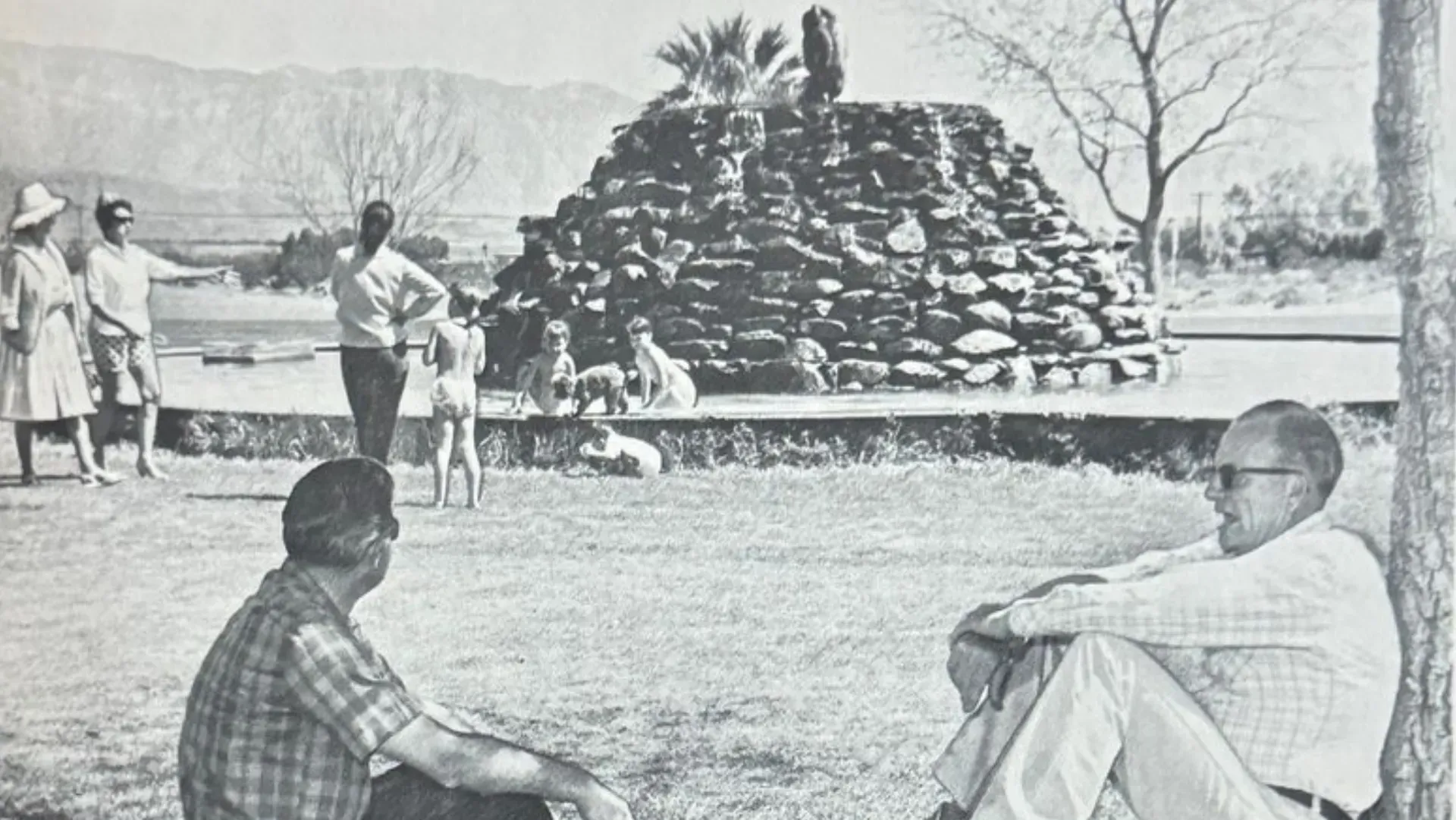
A town built around a park When Borrego Springs was laid out as a planned resort community in the late 1940s and early 1950s, Christmas Circle was the idea at its center. The plan imagined a lively three-acre park — a central town square on the model of a Mexican zócalo — ringed by shops on small lots, with the town’s essentials all facing the green: a grocery store, a bank, the newspaper office. Major roads were drawn to radiate outward from the Circle, tying it to the valley’s far corners and its resorts, while smaller pedestrian streets were meant to carry shoppers around the park itself. Getting people there took some trial and error. Developers first looked at Coyote Canyon for the way in, then pivoted to Montezuma Grade, and after several adjustments Palm Canyon Drive became the main entrance to the Circle. Not every piece of the grand plan came to life, but the bones of it are still visible in the way the town is shaped today. The land and the fountain The Circle’s land came as a gift. In the early 1950s the DiGiorgio family — the valley’s pioneer agricultural growers — donated it in honor of Alphonse A. “A.A.” Burnand Jr., the man remembered as the Father of Borrego Springs. The tribute ran both ways: at the center of the new park rose a $10,000 fountain, nearing completion in January 1952 under Burnand’s own supervision, built in memory of J.A. DiGiorgio, the pioneer developer. By the mid-1950s the little community was already paying to keep the fountain running and to decorate the Circle each Christmas.
Show More
Subscribe for Free Updates!