Borrego Springs Local • December 19, 2023
Borrego Springs’ SAR Aurora Phenomenon
Share

Capturing the Unseen: Borrego Springs’ Desert Aurora
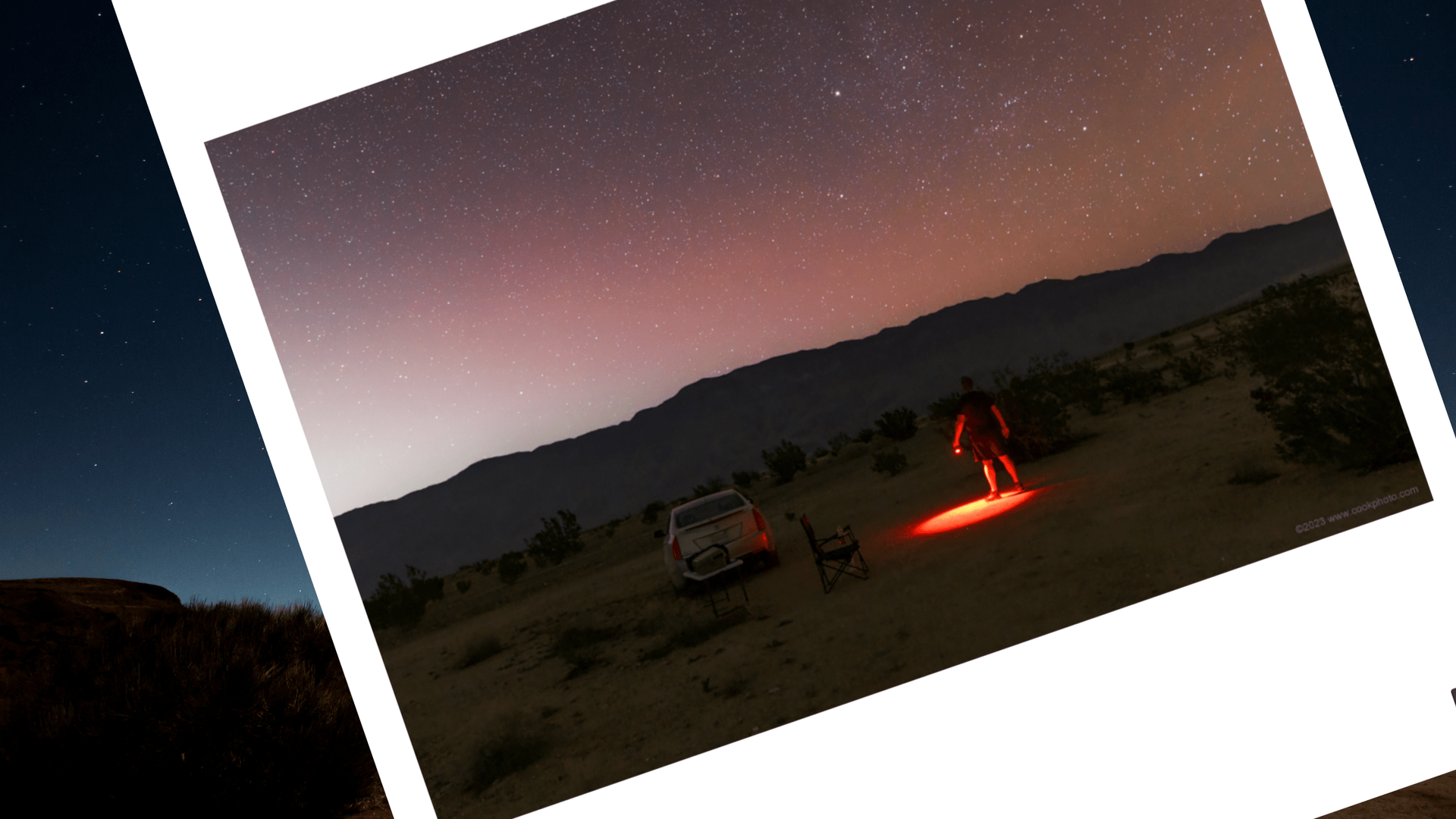
While the Northern Lights often steal the celestial spotlight, a recent phenomenon captured by photographer Chris Cook reveals that the heavens have more than one color palette at their disposal. On the evening of November 5, 2023, Cook witnessed a stunning display in the form of a Stable Auroral Red (SAR) arc, painting the skies above Borrego Springs, California, with hues of nocturnal red.
A Serendipitous Spectacle Above the Santa Rosa Mountains
Cook’s experience in Anza-Borrego Desert State Park, east of San Diego, was serendipitous. His trained eye and equipment—specifically, a Canon EOS 6D paired with a Tamron 15-30mm f/2.8 lens—were primed for moments just like this. The 20-second exposure at ISO3200 allowed him to capture the elusive SAR arc, a phenomenon usually invisible to the naked eye but nonetheless spectacular when revealed by today’s camera technology.
“Last night I was camped out in Anza-Borrego Desert State Park east of San Diego and ended up capturing a faint red aurora SAR! The arc of red was faintly visible in NNE sky above the Santa Rosa Mountains. While I’m used to capturing the northern lights from more northern regions, this was my first capture of an aurora from the desert at 33°N!! Canon EOS 6D, Tamron 15-30mm f/2.8 lens, ISO3200, 20 second exposure.”
– Photographer Chris Cook via Spaceweather.com
The Science of the SAR Arc
SAR arcs are a lesser-known cousin of the aurora borealis, occurring at lower latitudes. These shimmering red curtains of light become visible during geomagnetic storms, and while they don’t typically impact technology like their more famous relatives, their beauty is undeniable. The SAR arc observed by Cook is part of a long history, first identified in 1956, yet it remains a visual enigma to many.
The Ring Current: Earth’s Invisible Paintbrush
The red glow of a SAR arc originates from the Earth’s ring current system—a flow of electrons within the magnetosphere that, when energized during a geomagnetic storm, releases heat energy. This energy heats oxygen atoms in the Earth’s atmosphere, resulting in the SAR arc’s distinctive red light. This process was vividly demonstrated during the strong geomagnetic storm on November 5, when social media was awash with images of these red arcs, including those captured by Cook.
Borrego Springs: A Photographer’s Haven
The deserts around Borrego Springs offer a stark, serene backdrop that contrasts beautifully with the night sky’s vibrant displays. It’s a reminder that wonders await where you least expect them, even at 33°N latitude. For Cook, this marked the first capture of an aurora from the desert, adding a new chapter to his portfolio of celestial photography, which can be admired on his website and Instagram.
Embracing the Night Sky’s Mysteries
This event underscores the importance of preserving dark skies and the wonders they hold. For enthusiasts and casual observers alike, it’s a call to look up and embrace the mysteries that unfold above us. Borrego Springs’ rare SAR aurora is a testament to the ever-surprising nature of our universe, inviting us all to explore the night and its secrets.